
Let me paint you a picture.
It's Tuesday. You've got a guest recording tomorrow morning. Your producer pings you: "Did they ever send their bio and headshot?" You check your email. Nothing. You check Slack. Nothing. You check the shared Google Drive folder that three people have access to and nobody updates. Nothing.
So now you're spending 20 minutes hunting down an asset that a working system would have flagged, requested, and stored automatically weeks ago.
This happens to smart, capable teams every single week. Not because they're disorganized. But because the tools they're using were not built to actually run a workflow. They were built to track one.
That distinction matters more than you probably think.
The Problem Isn't Your Tools. It's How You're Using Them.
Trello, Notion, ClickUp, Google Forms, Calendly. These are all fine tools. Genuinely. But here's what they have in common: they wait for you.
They sit there, holding data, and they wait for a human to look at something, decide what to do, and take an action.
That's the model most podcast teams are running on. And it works, barely, when you have one or two shows. But as soon as you scale, that model breaks down fast.
Here's what the breakdown looks like in practice:
A guest confirms. Someone has to create the episode card. Someone has to send the intake form. Someone has to notice the form wasn't completed. Someone has to follow up. Someone has to copy the submitted info somewhere useful. Someone has to draft the prep questions. Someone has to send the briefing doc. Someone has to move the task status.
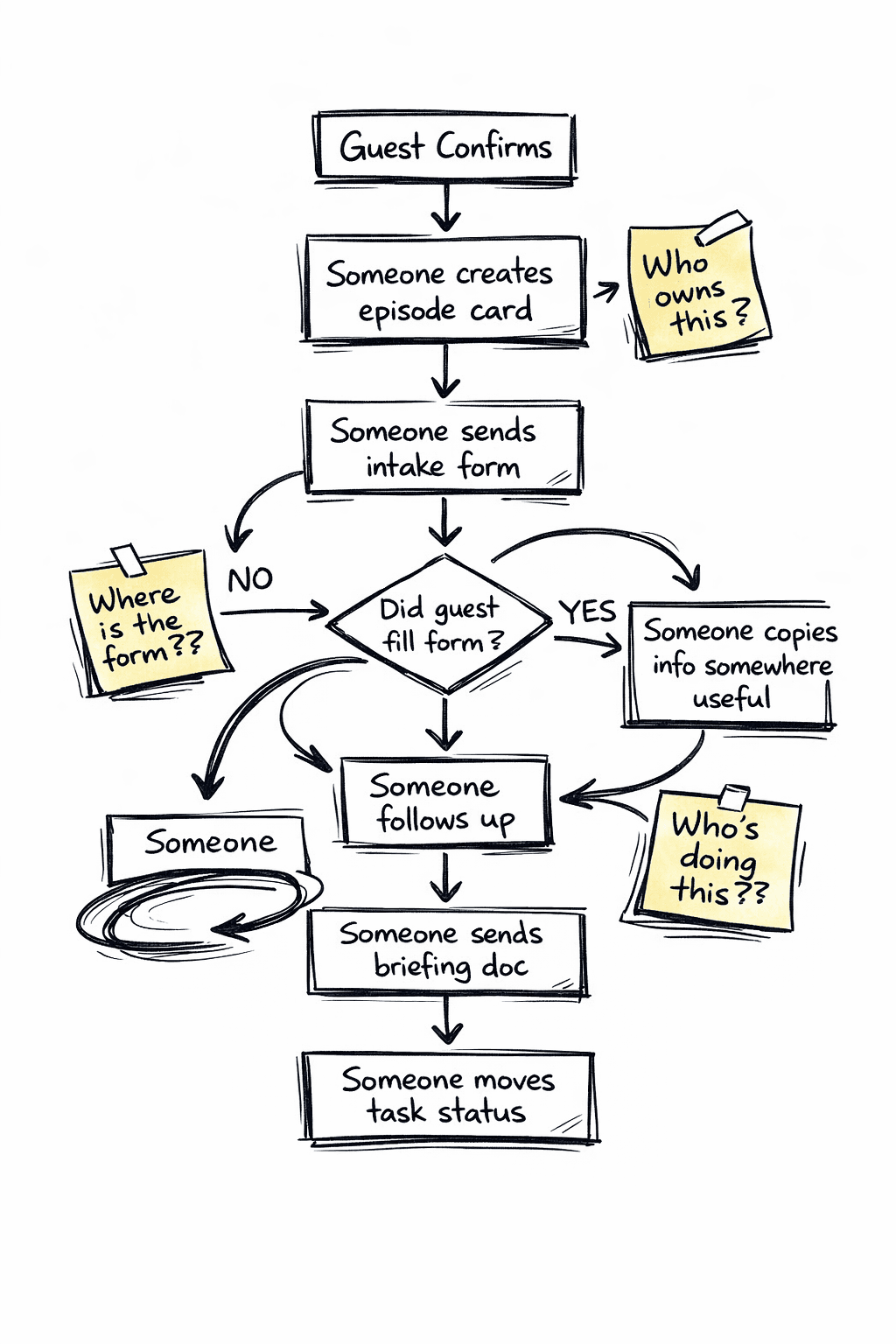
Every single one of those steps is a manual handoff. And every manual handoff is a point of failure.
When you're managing eight shows and twenty active guests at once, you're not running a production system anymore. You're running a coordination job. And it's exhausting.
What Agentic AI Actually Means
You've probably seen the phrase "agentic AI" showing up everywhere lately. Let me explain it without the hype.
Standard AI responds. You give it an input, it gives you an output. You paste in a guest transcript, ask for talking points, get talking points. That's useful. But it's still manual. You are still the one deciding when to use it and what to feed it.
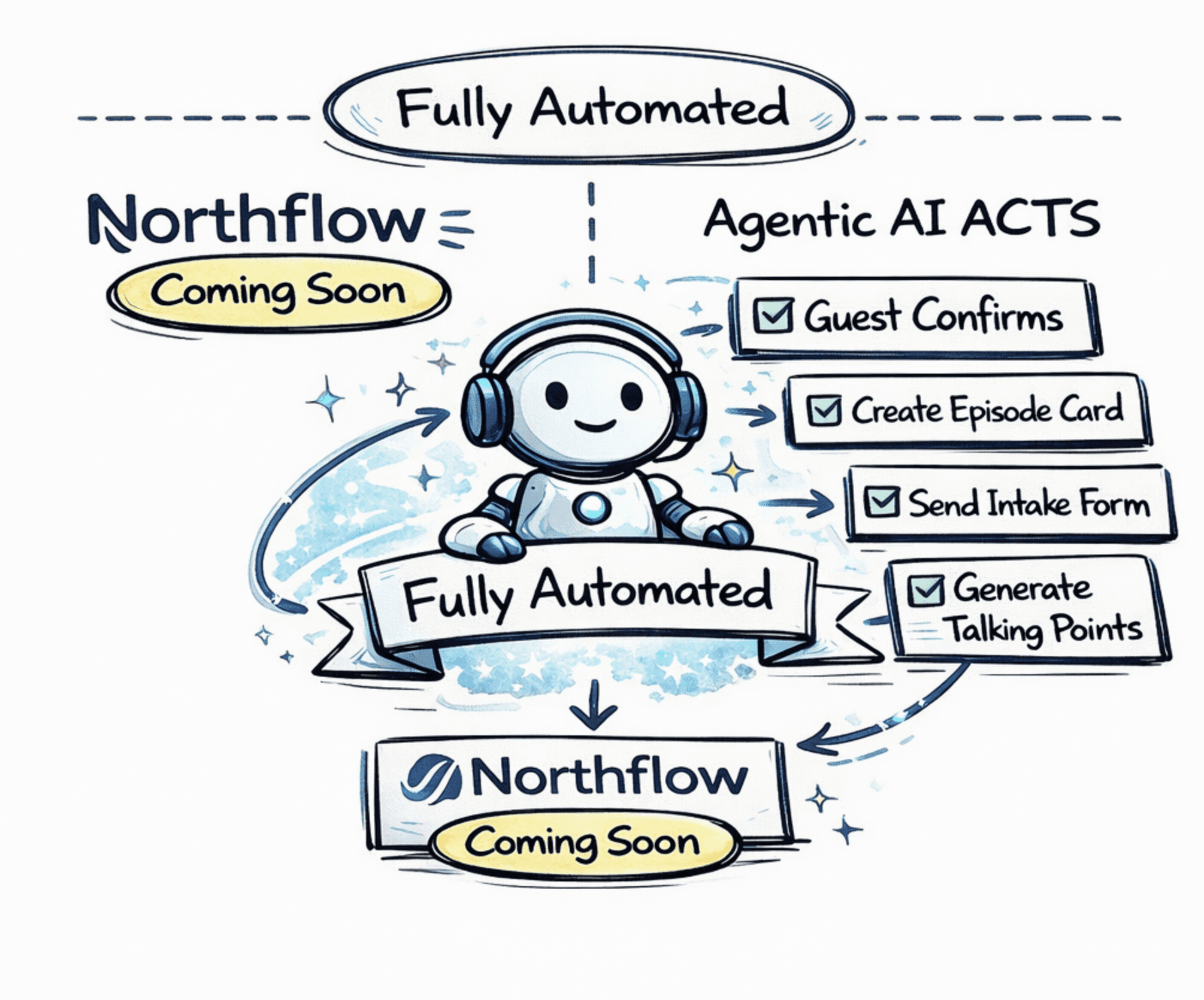
Agentic AI acts. It operates inside a defined system and takes actions on its own based on triggers, context, and rules you set up. It doesn't wait to be asked. When something happens, it knows what to do next, and it does it.
The difference is the difference between a reference book and a team member.
A reference book will tell you what to do. A team member will notice the situation, figure out what needs to happen, and go do it.
That's what agentic AI brings to your
workflow. Not just faster answers. Active movement through a system.
What This Looks Like in a Real Podcast Production Setup
Let's get concrete. Here's how agentic workflows change the day-to-day for agencies running multiple shows.
Guest onboarding that runs itself
Guest confirms the interview. The system automatically sends the intake form. If it's not completed within 48 hours, a follow-up goes out without anyone lifting a finger. When the form is submitted, the guest's bio, photo, and social links route directly to the episode record. The producer gets notified. The episode status updates. Nobody chased anyone.
Scheduling that triggers production
Booking a recording time isn't just a calendar event. It's a trigger. When the session is confirmed, the episode card gets created, the producer gets assigned, the pre-interview brief goes to the guest, and the recording task lands on the calendar. One action cascades into five. Your team shows up with everything already in place.
AI-drafted prep from what the guest already told you
When the intake form comes in, an agentic system can use that information to generate a first draft of interview questions. Not final. Not perfect. But a solid starting point that saves 20 minutes per episode. At 50 episodes a year, that's meaningful time back.
Status that moves itself
Instead of a producer manually updating a board and someone having to check it and a client having to ask "where are we?" -- the workflow knows. The episode gets recorded, the status advances, the client sees it. The system reports reality in real time, automatically.
None of this is experimental. These patterns are available today. The gap between teams using them and teams not using them is only going to grow.
The Mindset Shift: From Managing Tasks to Designing Systems
This is the part that's harder to talk about, because it's more about how you think than what tool you use.
Most teams approach operations reactively. Something needs to happen, someone does it. A status needs updating, someone updates it. A guest needs chasing, someone sends the email.
The shift with agentic AI is designing proactively. Instead of asking "what tasks need to get done?" you start asking "what should automatically happen when this event occurs?"
When a guest submits their form, what triggers? When a recording is complete, what moves? When a deadline is missed, what fires?
That question reframes you from task manager to system architect. And it fundamentally changes what kind of work you spend your time on.
The teams that figure this out early won't just be more efficient. They'll be able to take on more clients, run more shows, and deliver higher quality, without hiring proportionally more people to do it.
5 Things You Can Do Right Now
Action | What It Does | Where to Start |
|---|---|---|
Map one workflow end to end | Makes manual handoffs visible so you know what to automate | Pick guest onboarding, write every step |
List your most common "chasing" tasks | Identifies your highest-ROI automation targets | Ask your producers what takes the most follow-up |
Reframe tasks as triggers | Builds the mental habit that makes agentic design possible | Replace "someone needs to X" with "when Y happens, X should fire" |
Consolidate intake into one channel | You can't automate what enters through five different doors | Pick one form tool, one submission point, stick to it |
Build one automated follow-up | Proves the concept and builds confidence in the approach | Set up a 48-hour reminder for any form that isn't completed |
Start with one. Not all five. Pick the one that matches the thing that's been annoying your team the most and build from there.
What We're Building at Northflow
This kind of thinking is embedded in how Northflow works.
We designed it with episodes at the center of everything, with forms that connect directly to workflows, with guest flows that don't require the guest to create an account, and with a structure that's meant to move production forward rather than just log that work exists.
The full agentic layer is still being built. We're honest about that. But the foundation is already designed to support it, because we knew from the start that a system that just tracks things wasn't enough.
If you're building out your production operations and trying to figure out how to actually scale without it falling apart, I'd genuinely love to talk. No pitch. Just a real conversation about what you're running into.
The agencies that figure out how to design systems instead of just manage them will have a significant, durable advantage. Agentic AI is the accelerant. But the work of designing the system is yours. Start now, before you need to.